Medieval Art Examples Top Ten Famous Medievial Art Paintings
The about famous Renaissance paintings span a menstruum of some 300 years and marked a flow of revolution in art that has not been equaled to this day.
The Renaissance spans over three centuries from the 14th to the 17th century Ad and marked a nail in classical based artworks that have stood the exam of time.
Most notable were it's artists and their return to classical thinking and the philosophies of the ancient Greeks and Romans.
Today such names as Da Vinci, Michelangelo, Botticelli and Raphael are all considered geniuses and their contribution to art, the humanities, scientific discipline and philosophy is unequaled.
Renaissance paintings saw a breakthrough leap forward in terms of materials and techniques, with the linear perspective and highly accurate anatomical representation of the human class featuring heavily.
Many corking works were funded by either wealthy merchants or commissioned by the Catholic church building.
The following list of the almost famous renaissance paintings is not exhaustive simply it does detail the most notable works.
Famous Renaissance Paintings
1. Mona Lisa
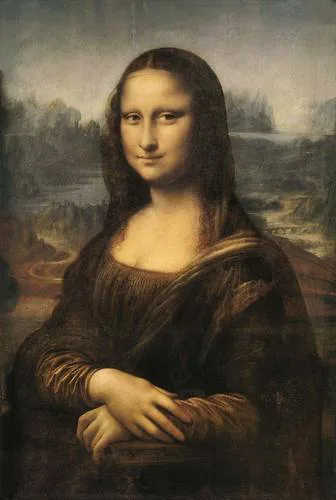
The Mona Lisa could be considered the single almost famous painting in the globe and also the most famous grinning to boot!
To his proper noun Da Vinci has relatively few completed canvases when compared to other prolific proponents of the time.
Nonetheless, all of his works are a considered true master pieces which is an accolade that is bestowed on very few people.
The Mona Lisa is a one-half height portrait and is believed to be of Lisa Gherardini who was the married woman of a rich Florentine merchant past the name of Francesco del Giocondo.
The Mona Lisa is now owned by the French public and is on brandish at the Louvre, it is held in trust for the public and can never be sold.
It was one time stolen by an Italian employee and taken back to Italy who claimed that is where it belongs. He was somewhen defenseless and the piece was returned to the Louvre.
At that place are long ques everyday just to catch a glimpse of her famous grin.
She is hands the most famous painting of the renaissance menses if non of all time.
ii. The Terminal Supper
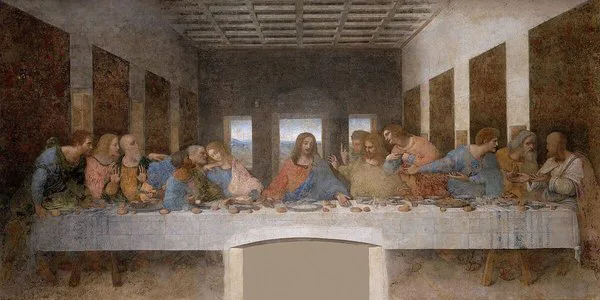
Similar a lot of famous renaissance works of art The Last Supper is a religious scene and depicts the final supper of Jesus and his twelve apostles and was painted by Leonardo Da Vinci.
It is a non the typical fresco that is normally painted on walls instead Leonardo decided to use his preferred oil paints instead.
Leonardo is said to favor oil every bit it is tiresome drying and allowed him to brand changes and take a slower more considered approach to the work.
Too Read: Leonardo da Vinci Paintings
Leonardo realized that if is he was to use oil paints then the natural moisture that permeates through almost stone wall buildings would take to be sealed other wise information technology would ruin his work.
To counter this he applied a double layer of gesso, mastic and pitch.
Throughout it's long history he painting had to be restored several times.
The result of both environmental and intentional damage, very little of the original top layer of oil painting is left.
iii. The Creation of Adam
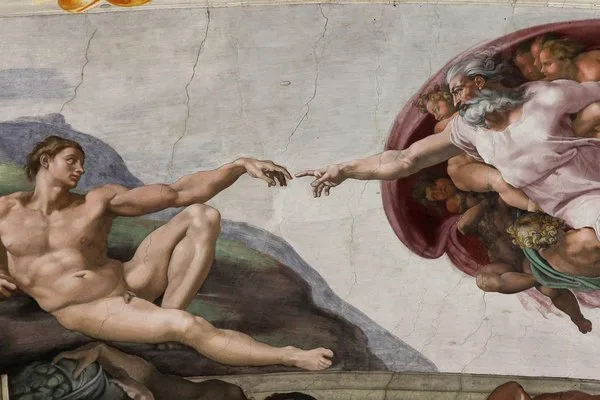
The Cosmos of Adam was painted by Michelangelo in roughly 1508 to 1512.
Information technology form the key image in the ceiling of the Sistine Chapels' ceiling.
The image depicts God giving life to Adam from the Book of Genesis and has become one of the almost iconic and reproduced images ever produced.
The total surface area is roughly over 500 square meters and it took Michelangelo over four years to finish what is one of the most complex and largest fresco paintings ever attempted.
In all there are some 300 figures, only the Creation of Adam focuses on God on the correct giving life to Adam who represents man.
Adam is lying on the edge of the globe in a rather relaxed way and God is carried by his angels reaching across to Adam to requite the gift of life through his touch.
To truly appreciate the grandeur of one of the renaissances finest art works you must walk under the ceiling of the Sistine chapel and gaze upwards.
four. Primavera
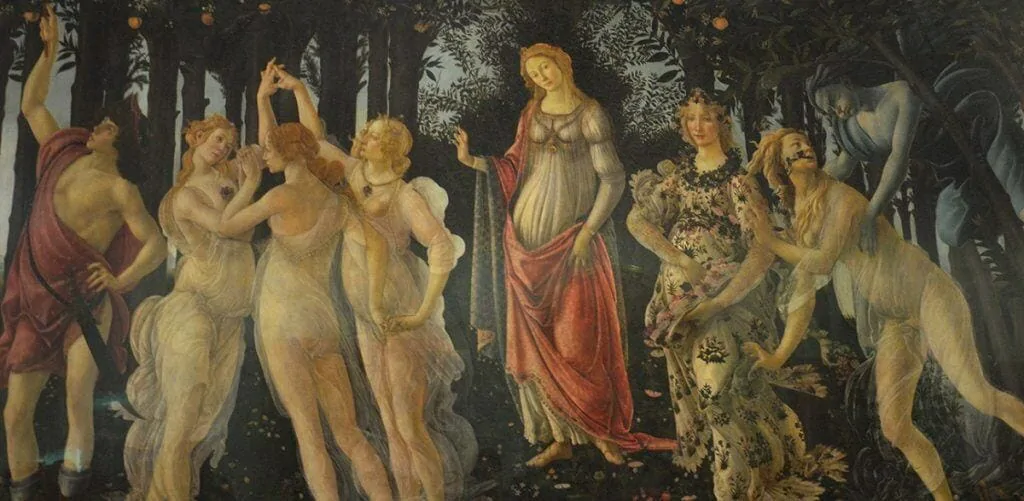
Sandro Botticelli is believed to take painted Primavera in 1482 the name in English means Bound and the painting is sometimes referred to as 'Allegory of Spring'.
The actual scene and what it represents is the crusade of much argue among artistic scholars and commentators with some saying information technology portrays a mythical allegory and others the changing of the seasons.
It is one of the finest renaissance fine art examples and is not just of note due to it'southward significant but besides in Botticelli's use of color which was rather hitting for the age that information technology was painted in.
five. The School of Athens
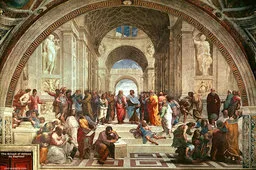
The School of Athens is a fresco that was painted exist Raphael between 1509 and 1511 in the Apostolic Palace in the Vatican.
The painting features almost e'er important Greek philosopher.
It is painted in the Stanza della Segnatura which is on the 2d floor in the Northward fly of the Vatican Palace.
It is one of iv large fresco's painted in that room with each of the 4 representing the branches of human knowledge which are Justice, Philosophy, Poetry and the School of Athens.
The use of perspective features heavily in the composition and the eye is drawn towards the two fundamental figures Plato on the left and Aristotle on the right.
On the left are philosophers that represent Plato'south philosophies and on the right philosophers that stand for Aristotle's philosophies with a sum total of fifty figures in the painting.
6. The Birth of Venus
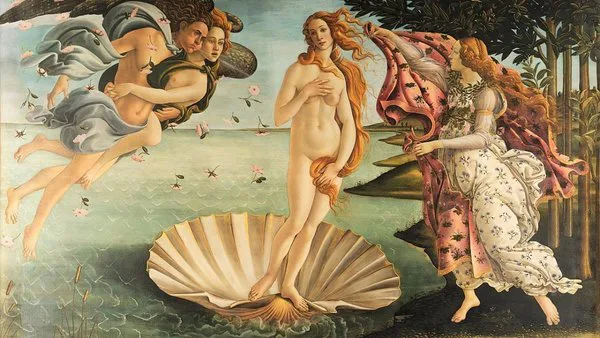
One of Botticelli'south finest renaissance works of art The Nativity of Venus features the Roman goddess Venus as she arrives on shore having been built-in fully grown at sea, she is delivered on a behemothic shell.
Sandro Botticelli was responsible for that other famous renaissance painting that depicts a mythological image the Primavera.
Also Read: Botticelli Paintings
Both great works of art were commissioned by the powerful cyberbanking dynasty the Medici who were extremely strong patrons of art in Florence.
Previous to this time the majority of works would have been painted on wood panels but the Birth of Venus is actually tempura on canvas.
Canvas had a distinct reward over woods as in boiling climates wood had a tendency to warp whereas canvas did not.
vii. Sistine Madonna
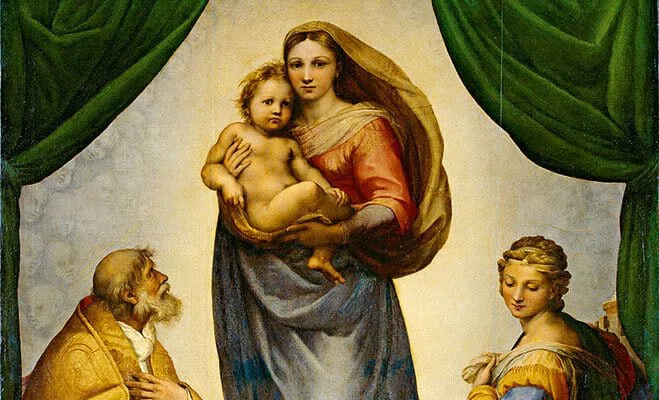
The Sistine Madonna was 1 of Raphael'due south last great works of renaissance fine art, he died but a few short years later.
The painting depicts the Virgin Mary holding the babe Jesus flanking her in the image are Saint Sixtus and Saint Barbara, below her in the foreground are cherubs that gaze upwards towards Mary.
The painting was painted for the Benedictine Monks in the San Sisto Monastery Piacenza which was hung in pride of place near the alter.
It later found it's way to Federal republic of germany in 1754 to King Agustus III of Saxony, upon it's arrival in Frg information technology caused considerable debate questioning the lines between art and faith.
The painting would later on move to Moscow after World State of war Ii and then finally returning to Germany in 1955.
Information technology is considered one of the nigh famous Renaissance paintings of the Virgin Mary and was a chief class from Raphael in terms of calorie-free and shadow.
8. The Last Sentence
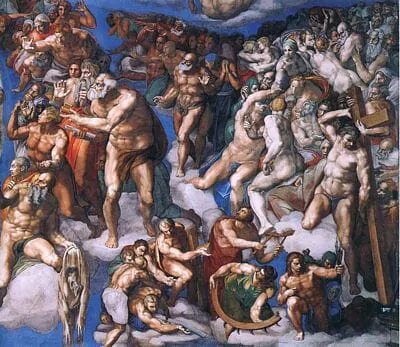
The Last Judgement is massive fresco painted by Michelangelo that adorns the whole alter wall of the Sistine Chapel in the Vatican city.
It took Michelangelo over four years between 1536 and 1541 to consummate due to not only it's size but also the complexity and the number of figures.
He started working on it 25 years after the completion of the Sistine Chapel Ceiling and past that stage was considerably one-time at 67 by the time it was completed.
Originally all of the males were painted as nudes but they were subsequently covered up by the add-on of painted draperies.
Initially the reception was mixed between praise and criticism with the nudes being a major talking indicate as as well was how muscular a lot of the figures were.
9. The Buss of Judas
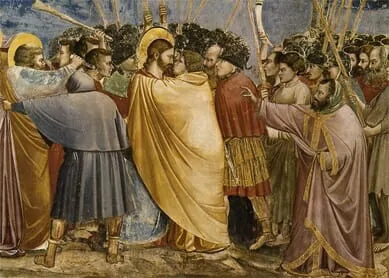
The Kiss of Judas is also known as the Betrayal of Christ and depicts the scene of Judas making Christ known to the officers of the Sanhedrin which led to his arrest and ultimate execution.
It was painted by Giotto di Bondone and was commissioned by the powerful banking family the Scrovengi'southward in the Scrovengi Chapel which was congenital past the family on the site of an ancient Roman loonshit.
The painting is probably about famous for the fact that it marked an end to the familiar medieval style of painting and heralded in the new wave of artistic revolution that was the early renaissance.
The series of fresco's that Giotto painted for the rich banking family unit were considered at the time to be the most modern works of art of whatever creative person.
10. The Assumption of the Virgin
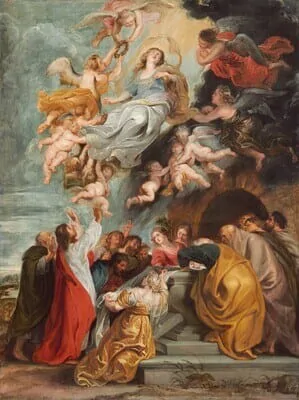
The Supposition of the Virgin also known every bit the Frari assumption is a painting by Titan that resides at the loftier altar at the Basilica di Santa Maria Gloriosca dei Frari in Venice.
Information technology was painted past Titan betwixt 1515 and 1518 and is the largest chantry piece in Venice.
For Titan information technology was the first time he sought to emulate the more modernistic dynamic scenes that Raphael and Michelangelo were becoming known for further s in Florence.
The painting is framed by massive marble columns and gilded edges and forms a rather striking slice when viewed from the other end of the church building.
Italian Renaissance Paintings
The Italian Renaissance painting movement marked a massive move away from the more than Gothic scenes of medieval art that preceded it to a return to more humanistic approach to both art and thinking.
Inspired heavily by the great Greek philosophers and thinkers the renaissance artists cast off the previous focus on symbolism and focused in that location attending to the private.
The rise of the wealthy merchants and cyberbanking families such equally the Medici from Italian cities such as Florence and Venice immune for a marked increase in financial support for up and coming artists to showcase there more modern way.
The reduced power and influence of the church besides had an impact as the spread of humanism was allowed to grow, whereas previous churches would have resisted such developments.
That being said the church were even so a massive consumers of Renaissance art with many of the near famous Renaissance paintings existence fresco'south that adorn the interior of some of Italy finest chapels and cathedrals.
The majority of renaissance fine art examples are to be found in Italia with many famous oil paintings still in good condition yet a large portion of the fresco's still surviving have been subject to substantial alterations past way of conservation.
Early on Renaissance Fine art (1400 – 1500)
Early Renaissance art was a bridge betwixt the previous Byzantine Gothic style of art and the more modern humanistic approach to both art, architecture, thinking and science.
The Florentine painter Giotto was one of the first to break complimentary from the in roughly 1300 to 1310 with his fresco'due south of the Scrovegni Chapel.
This catamenia between 1300 and 1400 is considered the proto-renaissance and marked a gradual divergence from classic symbolic Byzantine art with religious images featuring flat 2d painting techniques to a more naturalistic approach.
Giotto led the way for the early renaissance which was led past the likes of Brunelleschi, Donatello and Masaccio with the peachy banking families of Florence encouraging and funding this new movement.
Both Brunelleschi and Donatello revolutionized the utilise of linear perspective and gave life and depth to painting and architectural drawings.
High Renaissance Fine art
The high renaissance is a roughly thirty twelvemonth period were all of the groovy names were highly agile and oft competing with each other for various commissions.
Most historians would consider that high renaissance fine art started in roughly 1495 and ended 1520 and was signaled by the expiry of Raphael.
All of the smashing names in fine art, compages, sculpture, and the sciences particularly human anatomy were at the pinnacle of their creative powers.
Da Vinci, Raphael, Michelangelo and Bramante embraced new techniques, materials and the progression and refinement of linear perspective.
Massive canvasses and fresco's were undertaking on a never before seen scale and to this twenty-four hours are still considered some of the nearly famous renaissance paintings e'er fabricated.
Source: https://www.artst.org/renaissance-paintings/
0 Response to "Medieval Art Examples Top Ten Famous Medievial Art Paintings"
Publicar un comentario